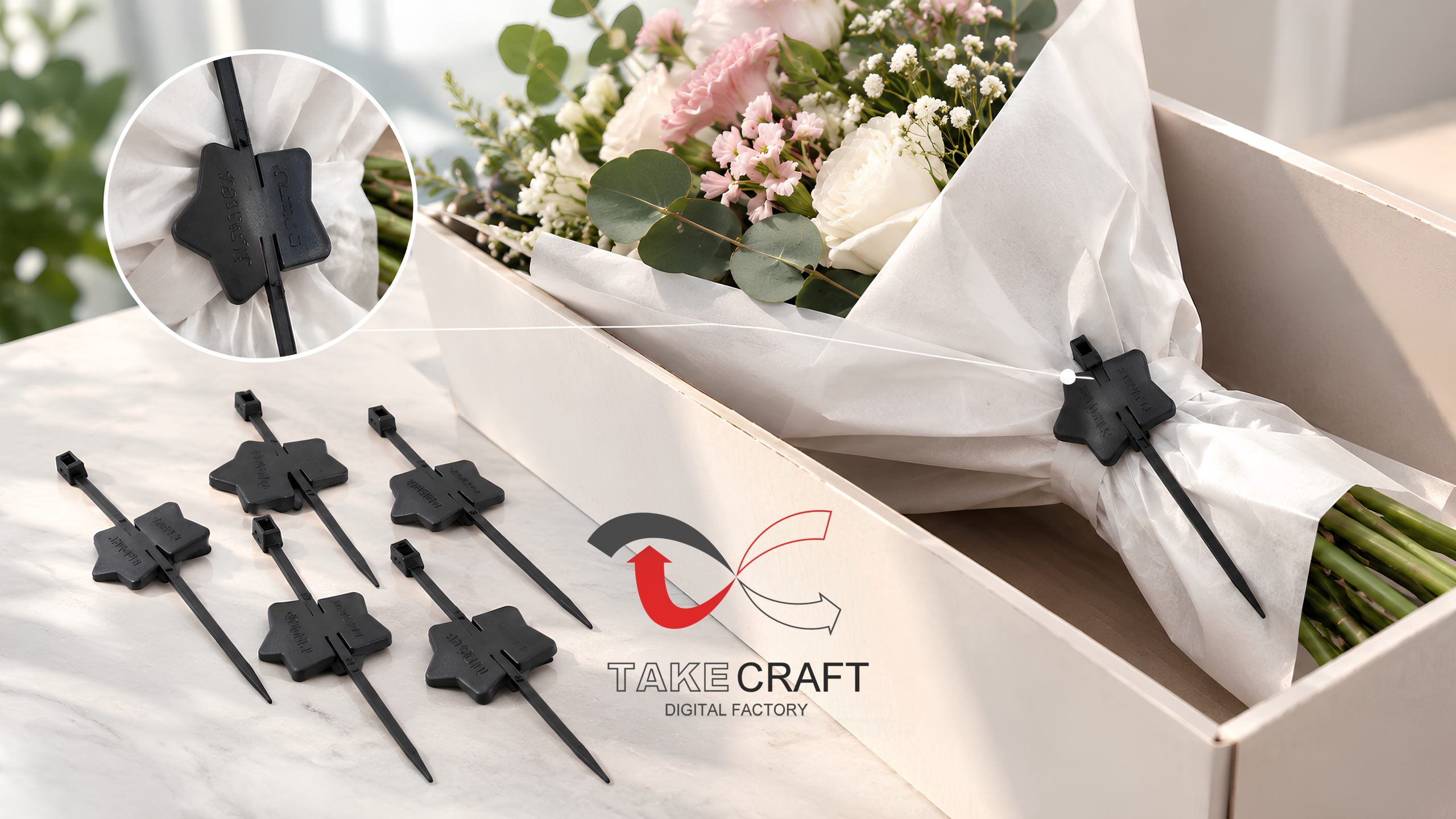
My Flowers approached Take Craft to solve a problem with securing flowers inside shipping boxes.
The customer had a basic 2D design and a real-world problem from actual use: conventional plastic clips used to secure the flowers were applying concentrated loads to the box during transportation, causing the packaging to tear and, in some cases, leading to deformation of the flowers.
Our task was not simply to reproduce the existing component.
The goal was to understand the problem, transform the initial 2D concept into a manufacturable 3D product, and develop a fixing mechanism that could perform reliably both during transportation and when handled by the end user.
In this project, the function of the plastic component was not limited to holding the flowers in place. It also needed to protect the integrity of the packaging and allow the end user to remove the product easily.
The initial solution provided by the customer consisted of a basic 2D design and a description of the problem experienced in the field.
The flowers were secured inside the shipping box using standard plastic clips. During transportation, however, the load applied by the clip was concentrated in specific areas of the box. This resulted in tearing and deformation of the packaging.
The required mechanical balance between the force applied by the fixing element and the strength of the box had not been achieved.
Over time, the load transferred from the plastic component to the packaging could create excessive stress, increasing the risk of tearing or deformation.
This did not only affect the appearance of the packaging.
Once the box was damaged, the ability to safely transport and protect the flowers was also compromised.
Therefore, the problem could not be treated simply as a matter of plastic component performance.
The first step was to avoid reducing the problem to a simple question:
“Is the fixing element strong enough?”
We evaluated how the component interacted with the box, where the applied force was concentrated, what loads it experienced during transportation, and how the flowers were positioned inside the packaging.
For this reason, we did not look for the solution simply by changing the material or increasing the strength of the clip.
Instead, we first reassessed how the component contacted the box and how the fixing mechanism behaved during transportation.
The objective was to secure the flowers adequately while preventing the applied load from becoming concentrated in a way that could damage the packaging.
The key engineering question was:
How much load should the component transfer to the box while still providing the required holding function?
Making the plastic component stronger alone would not necessarily solve the problem.
In fact, a stronger clip could potentially increase the load transferred to the box and make the original problem worse.
Therefore, the target was not maximum holding force.
The target was controlled and application-specific holding performance — enough to secure the flowers during transportation without unnecessarily stressing the packaging.
Based on this approach, we reassessed the design of the plastic component.
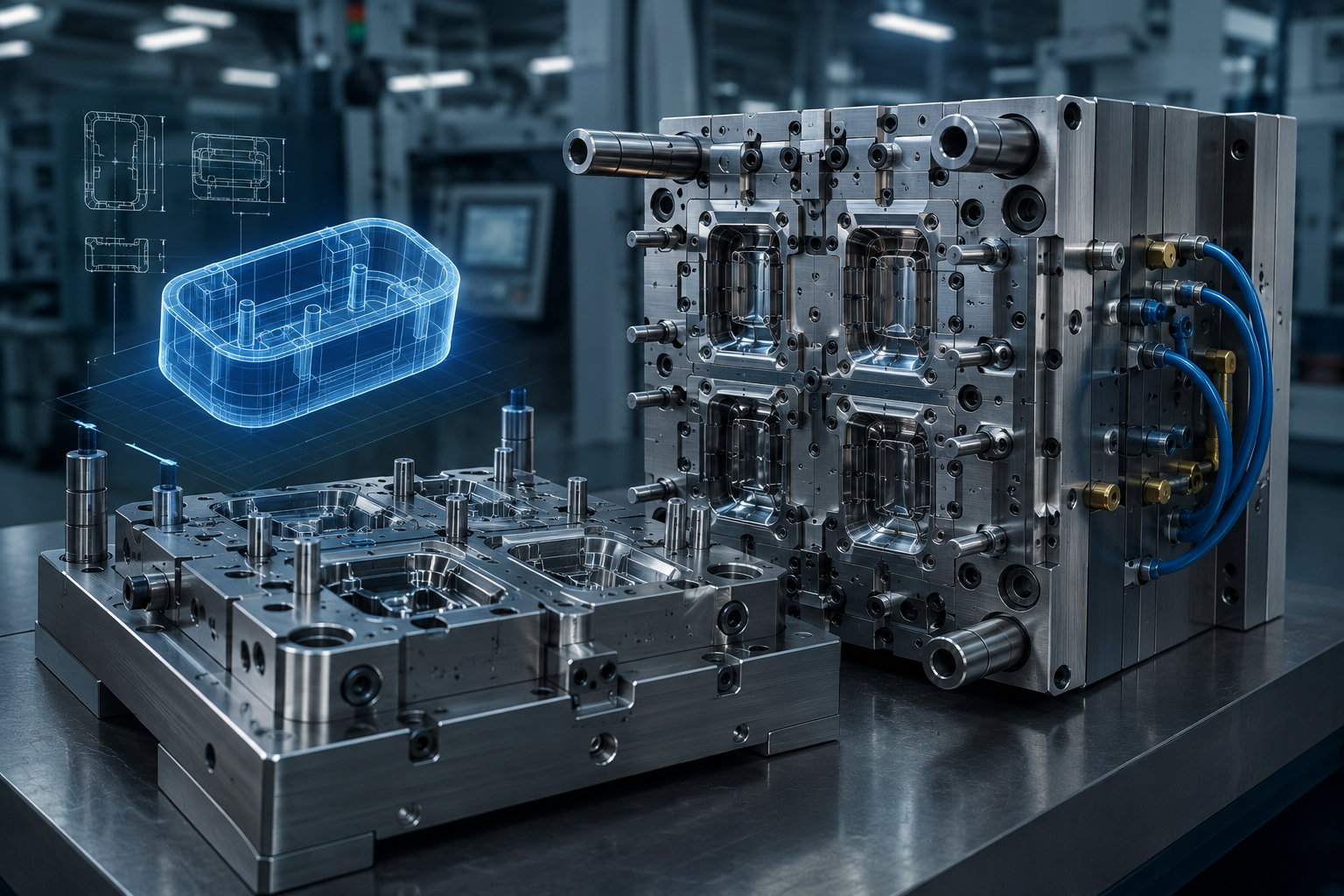
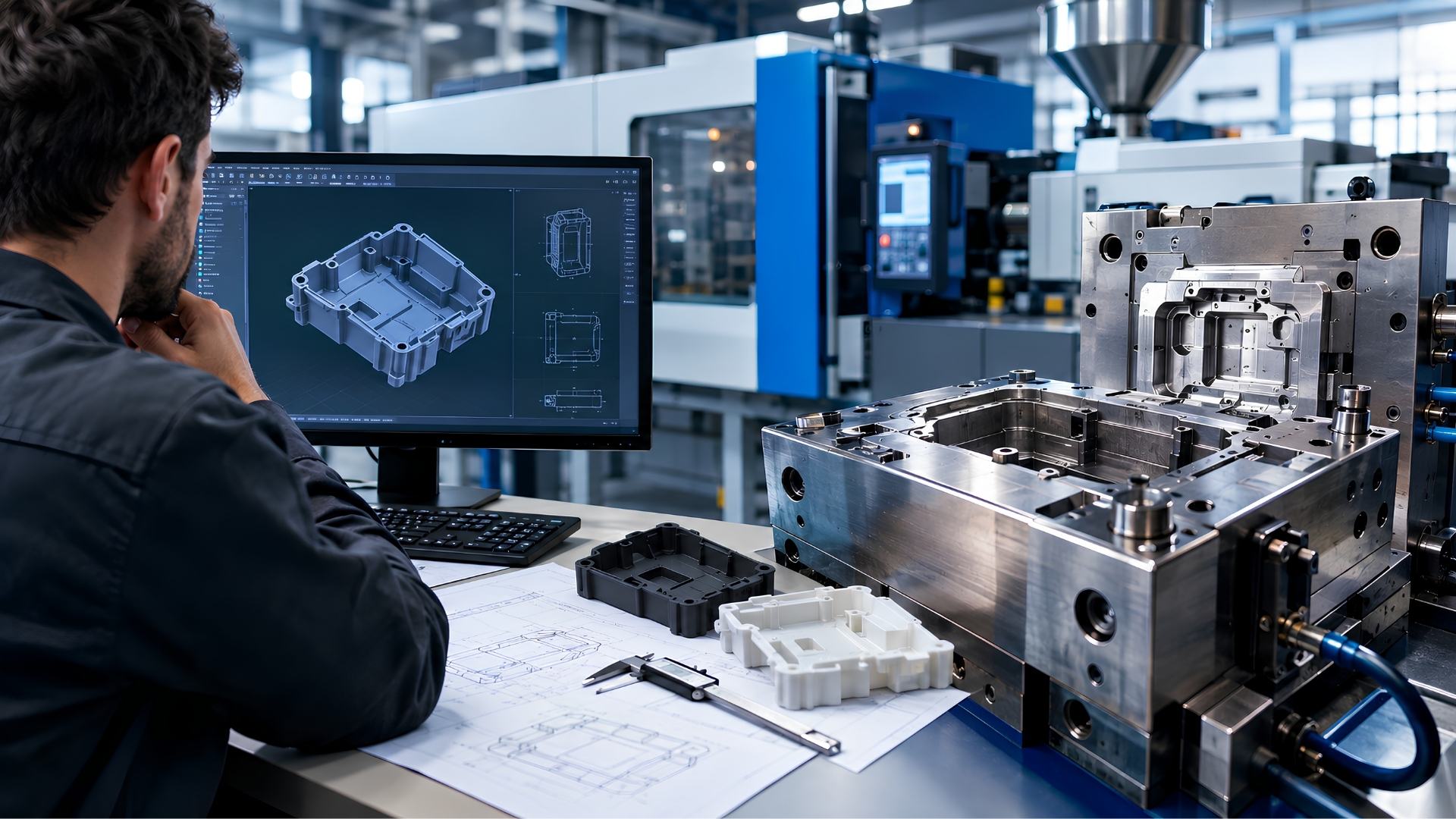
Using the customer’s 2D design as the starting point, we recreated and developed the component as a 3D model.
The 3D design allowed us to evaluate:
One of the critical design considerations was how to distribute the load that was stressing the box during transportation.
As part of this development, the geometry in the central section of the clip was modified and the operating mechanism was redesigned to achieve more controlled behavior.
The completed 3D design was presented to the customer for review. Following their feedback, the design was refined and finalized.
Manufacturability was also considered an integral part of the design process.
A design must do more than work theoretically. It needs to be suitable for plastic injection molding, have moldable geometry, and provide the required function under real operating conditions.
For this reason, the development process considered function and manufacturability together.
Once the final design direction had been established, material selection became the next critical consideration.
We were not simply looking for a material that could provide the required mechanical strength during transportation.
The way the end user would open the clip and remove the flowers from the box also had to be considered.
A material with a softer and more controlled mechanical response was selected so that the clip could provide the required holding function during transportation while also allowing the user to release it by applying force in the opposite direction.
The component therefore needed to satisfy two different requirements at the same time:
For this reason, the objective was not to make the solution “as strong as possible.”
The goal was to achieve controlled holding performance — neither too loose nor unnecessarily strong — according to the actual application requirements.
One of the important aspects of this project was that the component was not evaluated only as a production part.
The person opening the flower box was also part of the use case.
From the end user’s perspective, there was a different requirement: once the box was opened, the flowers needed to be released from the fixing mechanism.
The target was therefore to eliminate the need for a utility knife, scissors, or another cutting tool.
Through the redesigned operating geometry and selected material, the user can apply force in the opposite direction to release the clip and remove the flowers from the box.
This meant that the plastic product was evaluated not only from the manufacturer’s perspective, but also according to the actual moment of use.
The result was an approach in which function and user experience were treated as part of the same design problem.
The objective of the My Flowers project was not simply to reproduce an existing plastic component.
With the redesigned fixing mechanism, the flowers could be securely held inside the box during transportation while the load-transfer behavior that had been damaging the packaging was addressed through the design itself.
At the same time, the end user could release the flowers without needing a utility knife or scissors by applying force in the opposite direction to the fixing mechanism.
The development resulted in:
This case demonstrates that even a relatively small plastic component cannot be evaluated based on geometry alone.
When the component’s function, its interaction with surrounding components, material behavior, manufacturing requirements, and real-world use conditions are considered together, the right design decisions become much clearer.
Problem analysis
Understanding the packaging failure and identifying the underlying mechanical interaction.
2D-to-3D product development
Transforming the customer’s initial 2D concept into a detailed 3D product design.
Mechanism and geometry development
Reworking the fixing mechanism and central geometry to achieve more controlled load transfer and holding behavior.
Material evaluation
Considering both transportation performance and end-user operation when evaluating material behavior.
Manufacturability assessment
Developing a geometry suitable for plastic injection molding and practical production requirements.
You may have nothing more than a 2D drawing, a prototype, or an existing component that is not performing as expected.
At Take Craft, we evaluate plastic components from the perspectives of design, material, function, and manufacturability to help transform an initial concept or existing solution into a production-ready product.
📩 DM us on LinkedIn
🌐 www.takecraftengineering.com
📞 +90 312 870 1105
A 2D drawing is an excellent starting point for defining basic dimensions and design intent. However, for processes such as plastic injection molding, a 3D CAD model provides much more information for evaluating the part before manufacturing.
Moving from 2D to 3D helps engineers:
The transition from 2D to 3D is therefore not simply a modeling step. It is an important part of developing a manufacturable plastic product.
Plastic fixing components may be exposed to mechanical loads, repeated deformation, temperature variations, moisture, chemicals, and other environmental conditions depending on the application.
The wrong material can lead to cracking, excessive deformation, loss of holding force, or premature failure.
Material selection should therefore consider:
The appropriate material should always be selected according to the actual application rather than based on strength alone.
Yes.
With the right product design and mechanical features, a component can be designed to provide sufficient holding force during transportation while also allowing controlled release during use.
Possible design approaches include:
The key is to define the required holding and release forces according to the actual use case.
For reliable and cost-effective plastic injection molding, manufacturing requirements should be considered from the beginning of the design process.
Important considerations include:
A production-ready injection-molded component is therefore the result of considering part function, material behavior, mold design, and manufacturing process together.