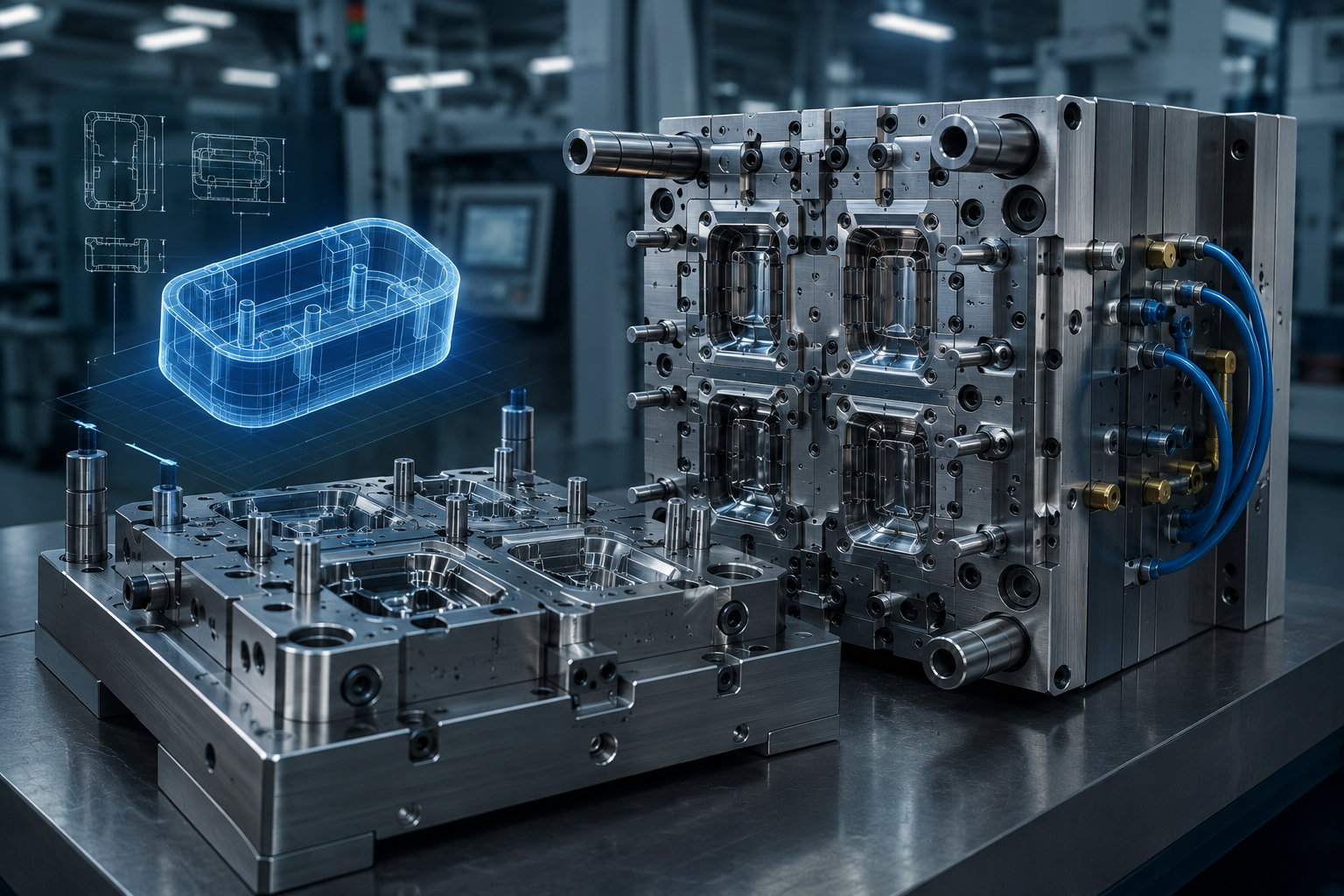
When companies request a quotation for a plastic injection mold, one question often comes first: Why are mold prices so different?
Two suppliers may receive the same 3D model and technical requirements but provide significantly different quotations. While one mold may appear to be much more affordable, the initial price does not always represent the total manufacturing cost.
The cost of a plastic injection mold depends on several engineering factors, including the part design, number of cavities, mold steel, production volume, tolerances, runner system, and expected mold life.
Understanding these factors helps manufacturers compare quotations more effectively and choose the right tooling solution for their production needs.
There is no standard price for a plastic injection mold. Every mold is designed according to the requirements of the plastic part, material, production volume, and manufacturing process.
The main factors affecting mold cost include:
Part geometry
Part size
Number of cavities
Mold steel selection
Tolerance requirements
Production volume
Runner system
Mold life
Cooling system
Surface finish
Sampling and validation requirements
Each factor can affect both the initial tooling investment and the long-term cost of production.
Part geometry is one of the most important factors affecting mold cost.
Complex features such as undercuts, deep ribs, thin walls, intricate internal details, and difficult surfaces may require additional machining, slides, lifters, inserts, or other special mechanisms.
A simpler part design can often reduce mold complexity and manufacturing time.
For this reason, Design for Manufacturability (DFM) is an important step before mold production begins. Reviewing the part design early can help identify unnecessary complexity and reduce potential tooling costs.
The number of cavities determines how many parts can be produced during one injection cycle.
A single-cavity mold generally requires a lower initial investment and can be suitable for prototypes or low-volume production.
Multi-cavity molds require more complex engineering and higher initial investment, but they can significantly increase production efficiency for high-volume projects.
The right cavity count should therefore be selected according to the expected production volume, machine capacity, part size, and target cost per part.
The steel used to manufacture the mold directly affects its durability, performance, and service life.
Higher-quality mold steels can provide better wear resistance, dimensional stability, and longer service life. They can be especially important when processing abrasive or glass-filled plastic materials.
However, using the most expensive steel is not always the best solution.
The appropriate steel grade should be selected according to:
Expected production volume
Plastic material
Abrasive or corrosive additives
Required surface finish
Expected mold life
Maintenance requirements
The goal is to select a steel grade that provides the required performance without unnecessary investment.
Tighter tolerances generally require more precise machining, additional mold adjustments, and more detailed inspection and validation.
However, not every feature of a plastic part requires extremely tight tolerances.
Applying unnecessarily strict tolerances can increase tooling costs without improving product functionality.
A practical approach is to define tolerances according to the functional requirements of the part. Critical areas such as sealing surfaces, assembly interfaces, or bearing locations may require tighter control, while non-functional dimensions may allow wider tolerances.
Expected production volume is another major factor in mold cost.
A mold designed for 20,000 parts requires a different engineering approach than one expected to produce several million parts. For low-volume production, a simpler mold with fewer cavities may provide a better return on investment.
For high-volume production, investing in multi-cavity tooling, higher-grade steel, advanced cooling, or hot runner systems may reduce the cost per part over the life of the mold. The objective is not to build the most expensive mold, but to build the mold that matches the production requirements.
The runner system affects both the initial mold price and production efficiency.
Cold runner systems generally have a lower initial tooling cost and can be suitable for lower production volumes.
Hot runner systems require additional components such as heated manifolds and nozzles, which increase the initial investment. However, they can reduce material waste, improve automation, and increase production efficiency in medium- and high-volume applications.
The right choice depends on the material, part design, production volume, cycle time, and overall manufacturing strategy.
Comparing suppliers only by quotation price can be misleading.
A lower-priced mold may have:
Shorter service life
Higher maintenance requirements
Longer cycle times
More material waste
Higher reject rates
Lower production stability
Reducing mold cost does not necessarily mean choosing the cheapest supplier.
The most effective cost reductions often begin during product development.
A DFM review can help:
Simplify part geometry
Reduce unnecessary undercuts
Optimize wall thickness
Define functional tolerances
Select the appropriate cavity count
Evaluate hot runner and cold runner options
Match mold steel to production volume
Improve cooling and cycle time
Solving these issues before mold manufacturing begins is usually much more cost-effective than modifying the mold after production has started.
Plastik enjeksiyon kalıp maliyetleri ile ilgili birçok sorun, kalıp imalatına başlanmadan çok önce tespit edilebilir.
Kapsamlı bir mühendislik değerlendirmesinde genellikle şu unsurlar incelenir:
Evaluating these factors during the design stage helps prevent costly mold revisions and production issues that could arise later in the process.
Plastic injection mold cost is determined by much more than the size of the mold or the amount of steel used.
Part geometry, cavity count, steel selection, part size, tolerances, production volume, runner system, mold life, and manufacturing requirements all contribute to the final tooling investment.
More importantly, these decisions influence production efficiency, maintenance, product quality, and cost per part throughout the life of the mold.
At Take Craft Engineering, we evaluate tooling requirements from an engineering perspective to develop solutions that match each project’s production volume, technical requirements, and long-term manufacturing goals.
If you are planning a new plastic product or evaluating injection mold quotations, our engineering team can help you determine the most appropriate tooling solution for your application.